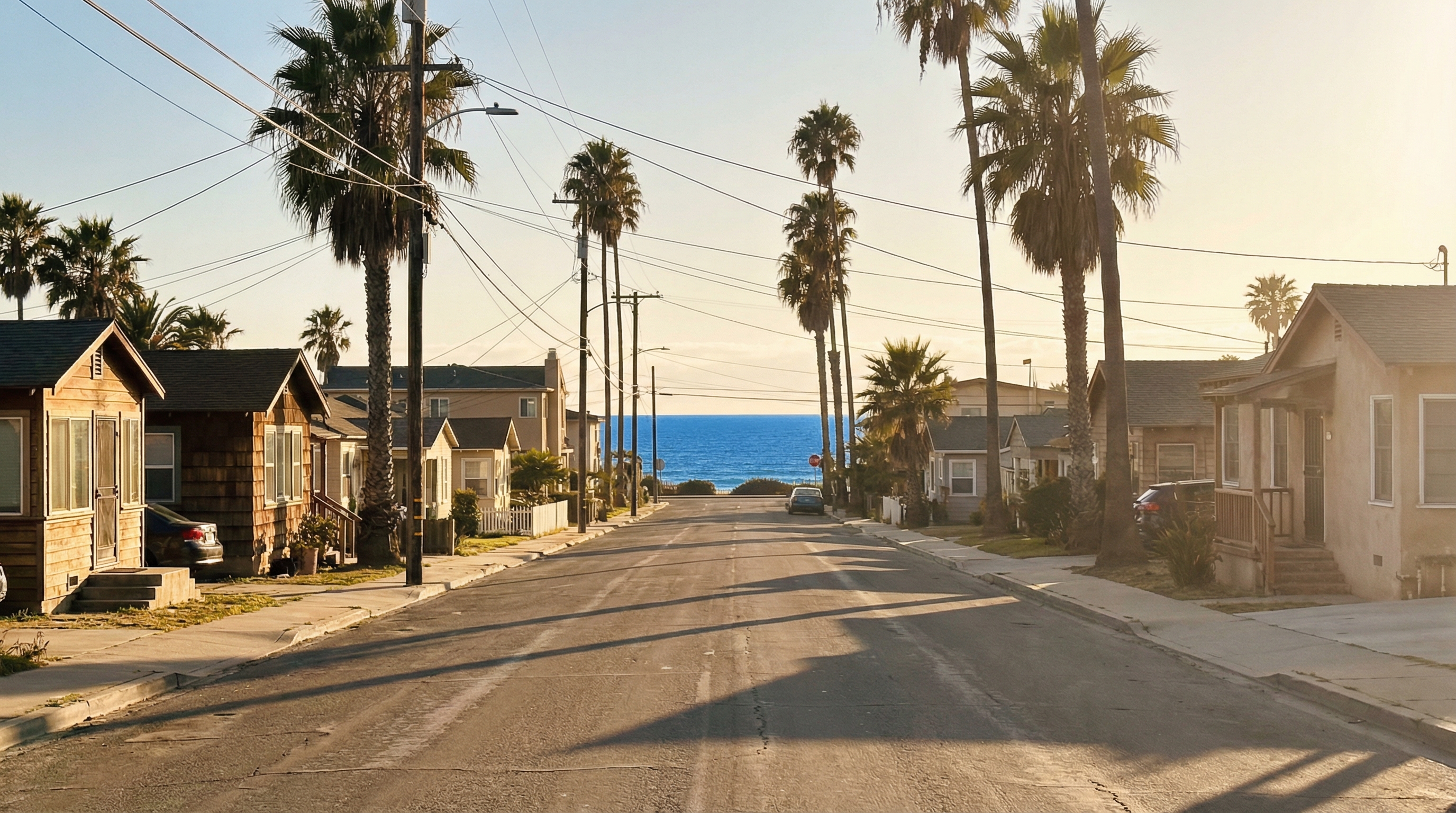
For most of my twenties, I lived inland. Not far from the coast — this is Southern California, so "inland" means thirty minutes from the beach on a good day, an hour and a half on a bad one. But far enough that the ocean was a destination, not a presence. I'd go on weekends, sometimes. I'd tell myself I should go more. I didn't.
Then I moved to the Westside. First to Mar Vista, then to a place near the beach in El Segundo. The ocean went from something I visited to something I could hear from my apartment on quiet nights. I could smell the salt in the air when I opened the windows. I could see, from the end of my street, the line where the sky met the water.
The change in how I think has been slow and hard to articulate. It's not the obvious stuff — the sunsets, the beach walks, the general "living the California dream" feeling that people imagine when they picture coastal life. It's subtler than that, and stranger.
Time moves differently
The most noticeable thing is what happened to my sense of time. When I lived inland, my days were organized by clocks and calendars. I woke up at a time, drove to a place, did things until a different time, drove home, and repeated. The days felt like units — containers to be filled, optimized, accounted for.
Near the ocean, time has a different shape. The tides come in and go out on their own schedule, and that schedule has nothing to do with yours. The light changes differently on the coast — the marine layer means mornings are gray and cool even in summer, and the late afternoon light has a quality that doesn't exist a few miles east. Sunsets are events, not backgrounds.
I started organizing my days less around the clock and more around what was happening outside. Surf in the morning when the swell is right. Walk in the afternoon when the fog burns off. Sit on the porch in the evening when the air cools. None of this is productive in any measurable way. All of it has made my days feel longer, in the good sense — like there's more in them.
Your tolerance for noise changes
I don't mean literal noise, although that changes too. I mean the general static of daily life — the urgency of emails, the constant pinging of notifications, the feeling that if you're not doing something you should be doing something.
When you live near the ocean, there is a large, indifferent thing at the end of your street that does not care about any of it. The ocean is not impressed by your deadline. It is not waiting for your response. It was here before you moved in and it will be here after you leave. This sounds like a greeting card, but the lived experience of it is genuinely disorienting at first.
I remember sitting at my desk one afternoon, stressed about something work-related that felt urgent, and then walking to the end of the block and looking at the water and feeling the whole thing deflate. Not because the problem wasn't real. Because the scale shifted. You look at something that stretches to the horizon and it's harder to convince yourself that the email you're worried about is the most important thing in the world.
Over time, this recalibration becomes your baseline. You don't stop caring about things. You just stop caring about things at the wrong volume.
What you think about when you're driving
This one is specific, but I think it's telling. When I lived inland, my drives were functional — point A to point B, traffic as an obstacle, podcast or music as a way to make the time pass. The freeways all look the same, and the sameness makes your brain go inward. You ruminate. You plan. You rehearse conversations that haven't happened yet.
Now most of my drives involve the ocean at some point. PCH south to El Porto. Lincoln down to Venice. The 1 up to Malibu when I have time to waste. And when the water is on your left or your right, your eyes go there automatically. You see the light on the surface. You see the swell lines. You see someone paddling out at the break near the pier.
Your brain goes outward instead of inward. You notice things instead of thinking about things. The difference sounds minor. It is not minor.
The edge effect
In ecology, there's a concept called the edge effect — the idea that the boundary between two ecosystems is more diverse and more alive than either one alone. The place where forest meets grassland, where river meets shore, where land meets water. The edge is where things happen.
I think living near the ocean puts you on an edge in a similar way. You're at the boundary between the built world and the natural one, between the controlled and the uncontrollable, between the thing you can schedule and the thing that operates on its own terms. And something about being on that boundary keeps you a little more awake than you'd otherwise be.
I don't want to romanticize it too much. Living near the beach in LA also means marine layer depression in June, sand in everything you own, and rent that's hard to justify by any rational measure. The salt air corrodes your car. The seagulls are sociopaths. Your non-coastal friends will stop feeling sorry for you very quickly.
But the tradeoff, for me, has been clear. I think differently here. I think better. Not smarter or more productively — just more clearly. The signal-to-noise ratio improved when I moved to the coast, and I don't think it's because the coast is magical. I think it's because having something large and alive and indifferent at the edge of your daily life is a kind of calibration that's hard to get any other way.
I lived inland for eight years and never thought much about it. I've lived near the ocean for three, and I can't imagine going back.